Seismic cycles on geometrically complex faults
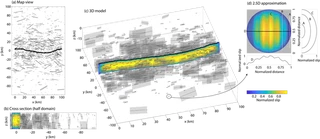 Example of a numerical model representing a rough fault embedded in a damage zone.
Faults are not planar features, but instead exhibit geometrical roughness at all scales, and are surrounded by highly fractured rock, which hosts small earthquakes and modifies the stress state on the main fault. In my group, we have worked both on the physical origin of off-fault damage (Milanese and Cattania, 2025), and on the effect of fault roughness and geometrical complexity on fault slip and seismicity patterns. We showed that roughness primarily controls fault dynamics by introducing spatial variability in normal stress, which modulates both the characteristic timescale for frictional failure and slip stability (Cattania and Segall, 2021). We have also explored the role of pore-fluid pressure perturbations in this setting (Aguilar Suarez et al., 2025), and the interplay between roughness and surface wear (Castellano et al., 2025). The effect of fault roughness is further amplified by the interplay between slip and friction, resulting in complex slip patterns during slow slip events (Sun and Cattania, 2025).
Accounting for this structural complexity significantly improves physics-based earthquake forecasts (Cattania et al., 2014; Cattania et al., 2018; see also Earthquake triggering and operational earthquake forecasting), and recent advances in earthquake detection techniques create opportunities to probe the physical processes driving seismic swarms, foreshocks and aftershock sequences. With support from an NSF CAREER award, we have implemented new numerical techniques to efficiently and accurately model earthquake cycles of a major fault embedded in a damage zone by employing a 2.5D representation of damage faults, that captures stress interactions in a 3D volume at a reduced computational cost; as well as implementing local proxies for inelastic stress relaxation due to plastic yielding and viscoelasticity, under which the system evolves toward a well-defined limit cycle without unphysical stress concentrations.
Media coverage: What causes earthquake foreshocks? on phys.org · Camilla Cattania named 2024 NSF CAREER recipient on EAPS News
Related publications: Cattania et al., 2014 · Cattania et al., 2018 · Cattania and Segall, 2021 · Aguilar Suarez et al., 2025 · Castellano et al., 2025 · Sun and Cattania, 2025 · Milanese and Cattania, 2025