How do earthquakes start?
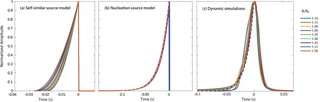 Far-field motion produced by different source models: (a) a self-similar model with constant rupture velocity, predicting an increase in source duration with size (radius R). (b) New model accounting for a gradual acceleration as the earthquake nucleates from an initial radius R0, (c) Dynamic rupture simulations are well reproduced by the theoretical nucleation model. From Cattania, 2023.
The seismological signature of earthquake nucleation. Elasto-frictional theories, confirmed by laboratory experiments, predict the existence of a finite nucleation dimension over which slow slip transitions to dynamic rupture. However, seismological observations remain rare and controversial, largely because small earthquakes are typically observed in the far field. In order to better constrain the nucleation process from far-field observations, I have developed a source model for earthquakes near the nucleation dimension (Cattania, 2023), which predicts systematic deviations from earthquake scaling laws typically assumed in seismology. This model offers the opportunity to interpret deviations from self-similar scalings in terms of the nucleation process, and potentially produce in-situ estimates of the nucleation dimension.
Linking interseismic friction evolution to earthquake nucleation. Classical nucleation models fail to account for the evolution of friction and sliding arising from heterogeneity in fault properties and loading conditions. To this end, I am developing a more comprehensive model of the seismic cycle that explicitly accounts for heterogeneity and time-dependent loading, and treats earthquake nucleation as the final stage of a gradual, interseismic slip evolution (currently under review). I find that the energy budget that controls earthquake initiation, propagation and arrest is profoundly affected by the gradual evolution of friction during the interseismic period, and a friction evolution law supported by recent laboratory experiments (the “slip law”; Bhattacharya et al., 2022) produces a feedback whereby friction increases rapidly ahead of a propagating rupture. This stabilizes slow slip and delays nucleation; on the other hand, once an earthquake begins, this feedback is suppressed, producing large earthquakes.
Finally, fault geometry provides another mechanism for precursory slip: on rough faults, normal stress heterogeneity can produce accelerating aseismic creep and foreshocks ahead of large ruptures (Cattania and Segall, 2021). See Seismic cycles on geometrically complex faults for more on this mechanism.
Related publications: Cattania, 2023 · Cattania and Segall, 2021