Earthquake complexity and scaling laws
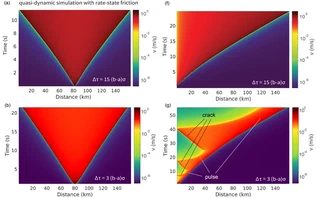 Back-propagating fronts can occur during unilateral earthquakes at low stress levels (bottom right), but not during bilateral propagation (left). This complex rupture behavior is predicted by our theory and confirmed by these numerical simulations (Sun and Cattania, 2026).
Universal scaling laws lie at the core of earthquake science, and they provide an essential bridge across subdisciplines. Are large earthquakes simply “scaled up” versions of smaller earthquakes - as implied by self-similar models - or are there processes or rupture patterns that only emerge at larger scales?
We’ve been addressing this question from the perspective of fracture mechanics, by developing theoretical models that describe how earthquake initiation, propagation and arrest arise from the interplay of friction and elasticity. We demonstrated that energy balance criteria predict that the timing and size of seismic events is controlled by the dimension of a fault relative to a characteristic length arising from frictional and elastic properties; for sufficiently large faults, this leads to power-law distributions commonly observed in earthquake catalogs (Cattania, 2019). On the other hand, small faults can rupture in simple, quasi-periodic sequences of identical events. We have developed theoretical arguments predicting the recurrence intervals and its scaling with magnitude, in agreement with observations of small repeating earthquakes worldwide (Cattania and Segall, 2019).
More recently, we demonstrated that fault dimension also has a profound effect on the rupture process of individual earthquakes, with an increase in rupture complexity and high-frequency radiation for larger earthquakes (Sun and Cattania, 2026). A remarkable finding of this study is that rupture complexity is an intrinsic property of laterally propagating earthquakes: the widely used earthquake crack model, which assumes uniform residual stress and predicts a simple rupture evolution, is fundamentally incompatible with lateral propagation on velocity-weakening faults. Instead, ruptures that exceed ~100 nucleation lengths experience back-propagating fronts, similar to the “boomerang earthquakes” increasingly reported in observational studies.
These efforts complement our work on fault geometry and heterogeneity, which provide a distinct mechanism for slip complexity - see Seismic cycles on geometrically complex faults.
Media coverage: Boomerang Earthquakes Don’t Need Complex Faults on Eos; New study unveils mechanism behind “boomerang earthquakes” on MIT News; Earthquake Statistics Vary with Fault Size on Eos ·
Related publications: Cattania and Segall, 2019 · Cattania, 2019 · Sun and Cattania, 2026 ·