Slow and fast slip at subduction plate boundaries
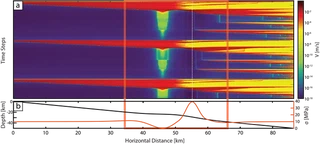 Megathrust seismic cycle with normal stresses heterogeneity modulated by a subducted seamount (orange box), showing interseismic creep in the weak patch uptip of the seamount peak. From Verwijs and Cattania, under review
The world’s largest earthquakes occur in subduction zones, and their size is affected by depth-dependent rheological transitions as well as structural heterogeneity. The factors controlling their initiation and final magnitude remain largely unknown. In my group, we have explored the complementary role of depth-dependent rheology (Moser et al., 2026) and stress heterogeneity (Verwijs and Cattania, under review) in determining the interplay of slow deformation and earthquakes in subduction zones.
Earthquakes are mostly confined to the uppermost few percent of the Earth, due to a transition from brittle to viscous deformation with increasing pressure and temperature at depth. The extent of the “seismogenic zone” is key to seismic hazard, as it determines the maximum area and landward reach of earthquakes in subduction zones. Taking a global perspective on shallow (0-70 km) seismicity, we show that the seismogenic zone consistently extends to approximately 50 km, independent of temperature (Moser et al., 2026). This unexpected finding challenges prevailing models of a temperature-controlled brittle-viscous transition.
Within the seismogenic zone, slip along subduction plate boundaries spans a continuum from fast earthquakes to steady creep and slow transients. We show that geometrical heterogeneity along the plate interface, such as seamounts on the downgoing plate, can generate a broad range of slip behaviors (Verwijs and Cattania, under review).
Related publications: Moser et al., 2026 · Sun and Cattania, 2025 · Verwijs and Cattania, under review.