Earthquake triggering and operational earthquake forecasting
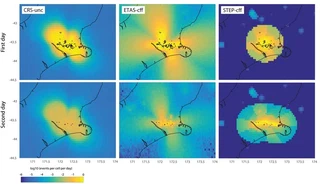 Maps of daily forecast in the first and second day after the Darfield mainshock. From Cattania et al., 2018
Aftershock sequences take place after all moderate and large earthquakes, and are a significant source of hazard. Physics-based models for Operational Earthquake Forecasting bring our physical knowledge of elasticity and friction into time-dependent, probabilistic earthquake forecasts, but face significant challenges (Mousavi, Cattania and Beroza, 2025).
Our approach to developing physics-based earthquake forecasts has been guided by an attempt to construct physically consistent and realistic models of the processes involved, by including time-dependent (aseismic) fault slip and a realistic fault geometry. We found that stress heterogeneity due to the geometrical complexity of a fault system has a first-order impact in model behavior (Cattania et al, 2014), and it significantly improves performance (Cattania et al., 2018, Mancini et al, 2019). Moreover, deep afterslip following large subduction earthquakes significantly contributes to triggering seismicity on shallow crustal faults (Cattania et al, 2015). We have also explored earthquake triggering due to other transient stress sources, from viscoelastic postseismic relaxation in Southern California (Pollitz and Cattania, 2017) to rainfall-driven, tidally modulated triggering at Mt. Hochstaufen, Germany (Hainzl et al., 2013).
Media coverage: International collaboration studies the predictability of earthquakes on phys.org
Related publications: Cattania et al., 2014 · Cattania et al., 2014b · Cattania and Khalid, 2016 · Cattania et al., 2018 · Mancini et al., 2019 · Pollitz and Cattania, 2017 · Hainzl et al., 2013 · Cattania et al., 2017 (Miyakejima) · Cattania et al., 2017 (East Pacific Rise) · Mousavi, Cattania and Beroza, 2025